
This guest blog by Hannah Gibson reflects on living with chronic migraine, using creativity to share her story, exploring the experience of pain, light and time with words and photos.
How do you make visible an experience that defies language? How do you show what it means to wake each morning not knowing whether sunlight around a corner will trigger an aura, whether today is a day the words will come out stilted, whether it’s a day you can function and participate in life, or a day that brings you to your knees?
I had my first migraine aged 10. I didn’t know it was called that, only that fuzzy, strange, pulsating shapes appeared like spots my vision, eventually growing to distort it all. By the time I began throwing up with the pain infiltrating the right side of my head, I thought the world was ending.
I didn’t learn to say “chronic migraine” until I was my early thirties, mid-PhD, sitting across from a neurologist who finally gave the thing a name. The diagnostic criteria are almost absurdly clinical for something this consuming: headache on fifteen or more days a month, for more than three months, at least eight of those days meeting the full criteria for migraine. At its worst, I had sixty migraine attacks in one month. At its best, around ten. Even with every funded or unfunded medication I could get my hands on, I have never had a day without some symptoms, because the nature of this disease is that for some of us, it does not fully leave.
But none of that number-crunching tells people what it’s like. For me personally, yes, there’s severe pain in one side of the head, and often the face. There’s also extreme sensitivity to noise, which is one of the worst parts. Irritability. Nausea and vomiting. Difficulty processing sound and speech. A cognitive fog that swallows words before I can find them. Weakness in my limbs. As I wrote once, about it:
Do not say
"just a migraine."

You have not been
the cracked ceiling.

The scream
inside a whisper.

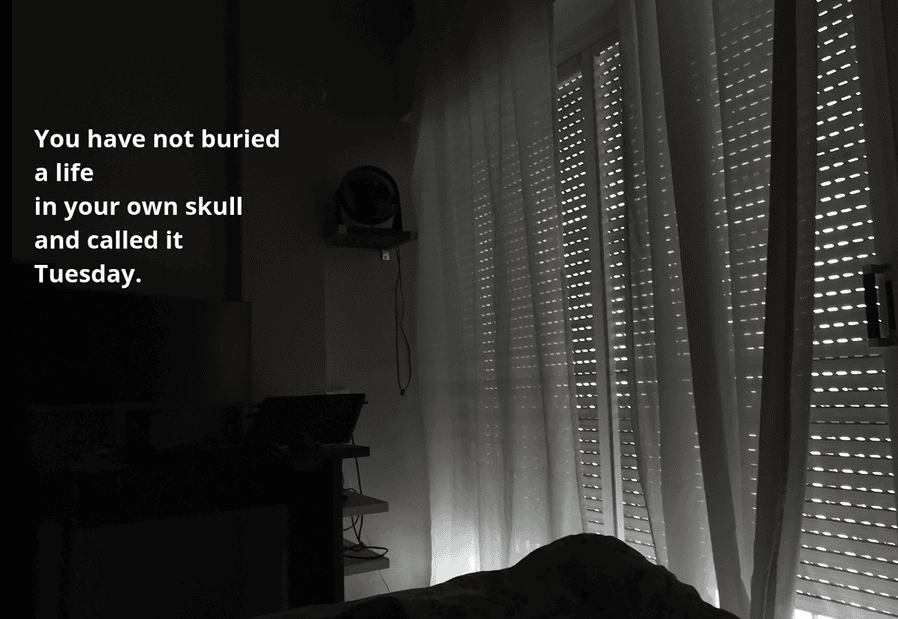
You have not buried
a life
in your own skull
and called it
Tuesday.

What does it mean
to lose a day
no one else remembers
but you?
It was living in Spain for two and a half years that I really understood my relationship to light: the irony of swapping the Wellington wind for the Spanish sun. Photophobia sounds almost mild in the mouth, a sensitivity, a preference for shade. But it isn’t that. It’s the sun catching my eye as I turn a corner, followed by the world turning painfully intense. It’s flashing lights in a television show. It’s the ordinary brightness of a Tuesday. Or, if it triggers an aura, it’s something in my visual field starting to lie: a shimmer building at the edge of vision, a zigzag replacing what should be there, my partner’s face going quietly, impossibly, incomplete. Light isn’t just painful in migraine; it’s hallucinatory, unreliable, capable of rewriting what I’m looking.
So, the curtains close. And this is where it gets complicated, because darkness is never just refuge, just the only bearable environment, just the place I seek when it’s at its worst. It’s also erasure. Plans cancelled. A slither of light sneaking in under the door while the world carries on in motion without me. It is treatment and desperate isolation at the same time.
But light didn’t only feel cruel. Some of my clearest memories from the dark are gentler: watching shimmers of light slip in through the gap in the blinds and dance across the wall, trees outside moving it, and tracing gold and soft shapes. For a moment, watching it consumed my focus and while it never lasted or fixed anything, it pulled me out of the suffering, briefly, in a way I still don’t fully understand.
Then, somewhere between the two, is the part almost no one asks about: the liminal stretch before the acute attacks even arrive, when the body already knows and the self hasn’t caught up yet. I’ll catch myself squinting at nothing, or needing to reread a sentence carefully, or reaching for earplugs, all hours, and sometimes days, before I have language for what’s happening.
It was Spain that gave me the material and the reason: I began photographing my life with migraine because I didn’t know how to say any of this out loud. I never saw myself as a photographer, but during a course for work, my daily experience of light and darkness through the lens of migraine became a perfect project. Some of those images found their way into a video montage, built around light and darkness once I saw everything I’d documented laid out together; That thread was the one I could hold onto and follow from start to finish, not because it’s the whole of what this illness is. Others stayed here, paired with words, because they needed a sentence beside them to make sense.
Some images I took are tongue-in-cheek: a plate of preventative and abortive medication, supplements, anti-nausea tablets etc that I may take in a bad month, laid out with a knife, fork and spoon to depict the dinner plans I cancel.
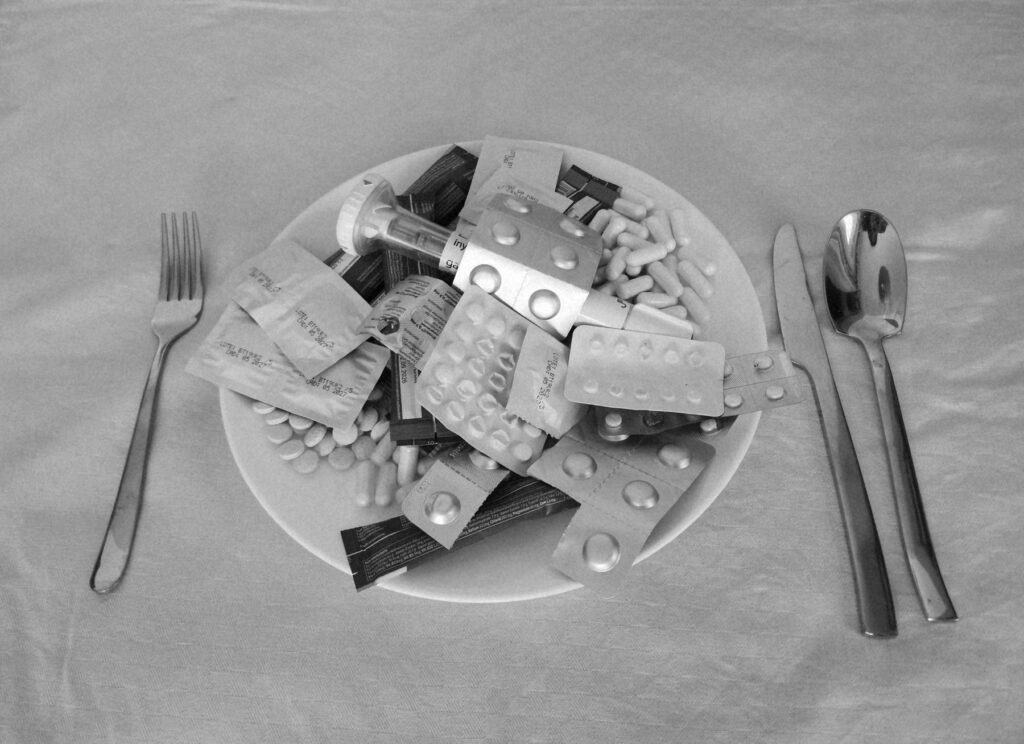
Photo: A white plate upon a white tablecloth filled with different types of medications and injections. There is a fork to the left of it and a knife and spoon to the right.
Others are quieter: the hospital room my neurologist ushered me into once a month for nerve blocks. It showed the bare minimum lights they kept on.
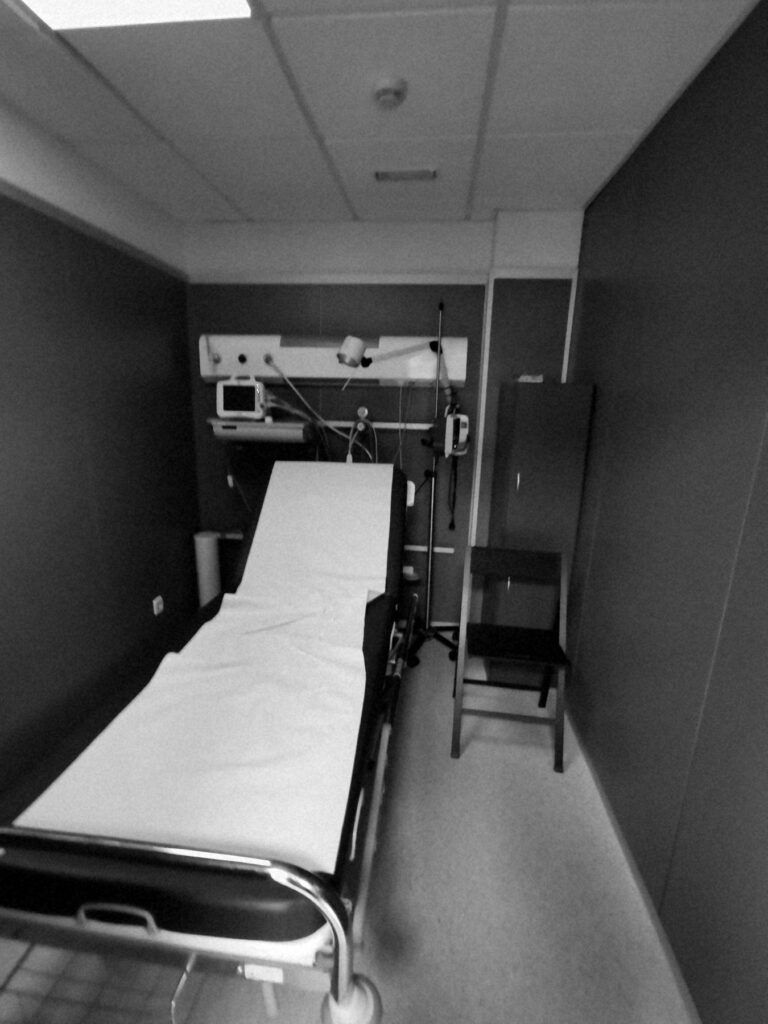
Photo: An empty hospital treatment room, bed made up, monitor and single chair, lit only by a small skylight.
Then there’s the noise-cancelling headphones hanging next to the dog leash, both just part of the daily gear now.
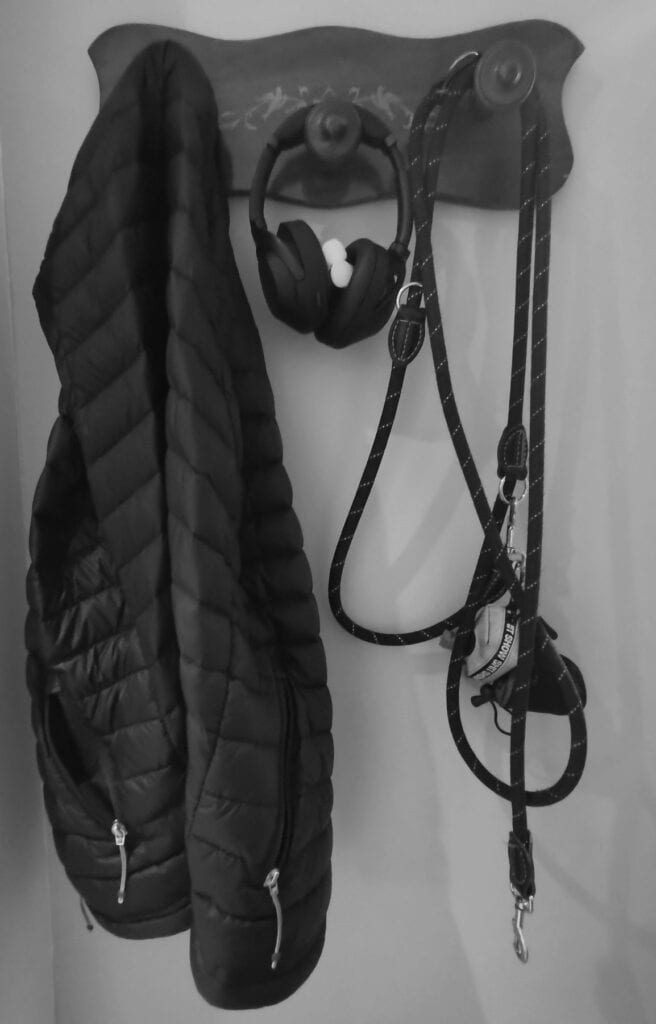
Photo: Noise-cancelling headphones and a dog leash hanging side by side on a wall hook.
My body turned away, hunched, waiting it out.
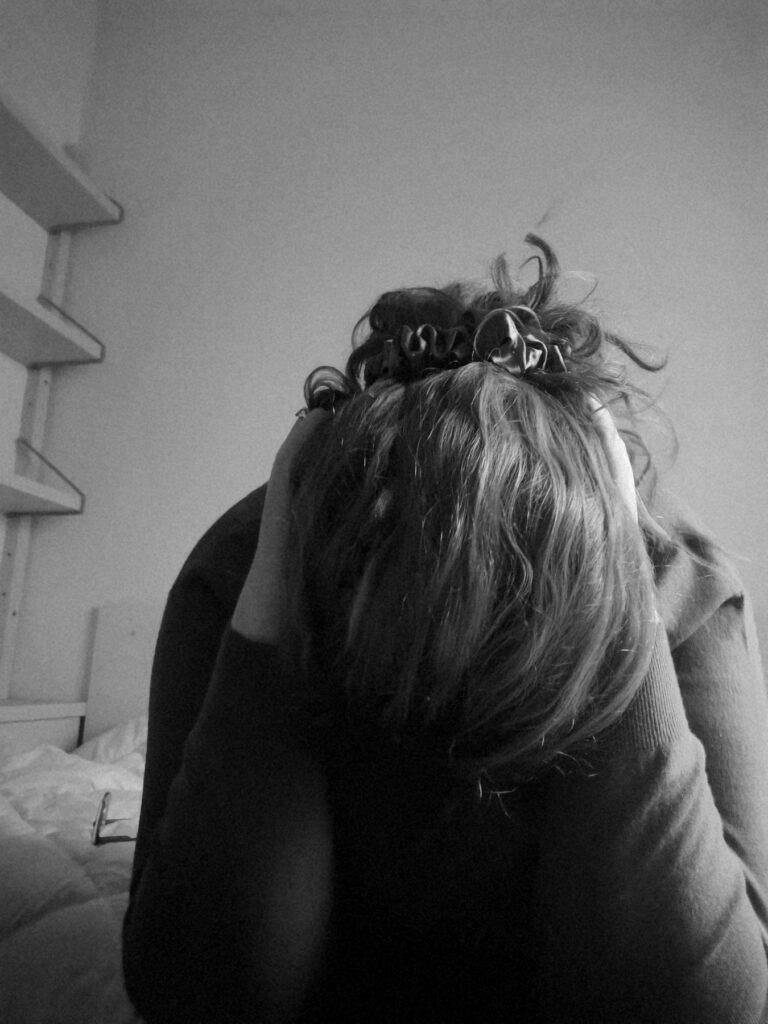
Photo: A person facing the camera, head bowed, one hand resting in their hair, in a dim room.
And then, the other side: golden light pouring back in through the window once an attack finally lifts, and something close to euphoria because I survived. Light has never felt so glorious. Like coming up for air.
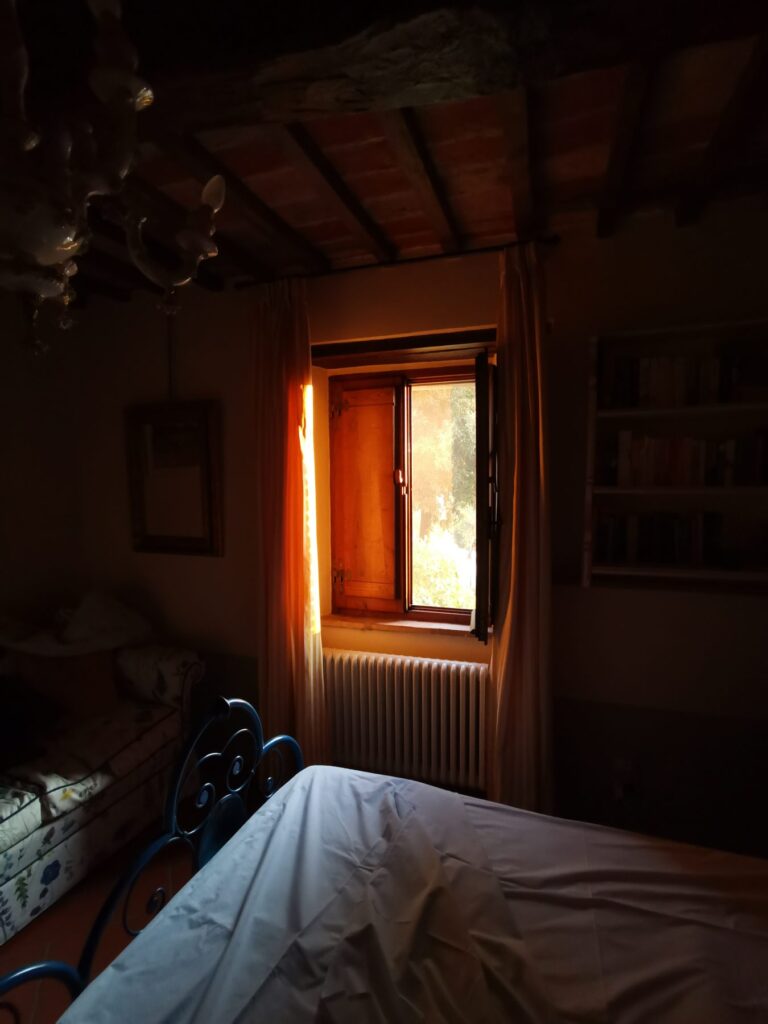
Photo: A dark bedroom with a shaft of golden light coming through a half-open window.
It is important to acknowledge how migraine intersects with other health conditions I have that can amplify and be impacted by symptoms described. The photographs and poetry I wrote as part of the project is one part of a much larger, more tangled experience, told as honestly and completely as I could.
WATCH
The video montage this piece accompanies, When the Light Fractures, explores these same shifting contours of light, darkness and pain in motion. Please note that there is no voice over reading the poetry at the time of publishing this piece. Watch it here.