Tension headache

Understanding tension headache
Tension headache usually causes mild to moderate pain and isn’t a sign of a serious medical problem. Often you can manage it with simple self-care at home. It’s a good idea to talk with your healthcare provider if headaches are becoming more frequent or affecting your daily life.
What is a tension headache?
A tension headache causes a constant ache or feeling of tightness around your head. Many people describe it as feeling like someone is squeezing their head or wearing a tight headband.
People experience tension headache differently, but common symptoms include:
- a dull, steady ache on both sides of your head
- a feeling of pressure or tightness around your head
- tight or sore muscles in your neck, shoulders or scalp
- pain that lasts from 30 minutes to several hours, and sometimes longer.
Tension headache usually occurs later in the day.
Often with a tension headache you can continue with your usual activities, although you may not feel at your best.
What causes tension headache?
The exact cause of tension headache isn’t fully understood, and there’s probably more than one reason why it happens.
For many people, tension headache is linked to everyday things that place strain on your body or mind.
Common triggers include:
- stress or worry
- feeling tired or not getting enough sleep
- sitting at a desk or computer for long periods
- poor posture
- tight muscles in your neck, shoulders or jaw
- skipping meals
- not drinking enough water.
Triggers are different for everyone, so learning what brings on your headache can help you manage them.
How is tension headache treated?
Tension headache can be treated at home.
When you get a tension headache you may find it helps to:
- take a break and rest if you can
- apply a warm or cooling pack
- go for a gentle walk or do some light exercise
- practise relaxation techniques such as slow breathing or mindfulness.
Over-the-counter medications such as non-steroidal anti-inflammatory medications (NSAIDs) (for e.g. aspirin, ibuprofen and naproxen) and paracetamol can help. Taking paracetamol with caffeine can also help.
Try not to use pain medicines too often. Taking them regularly over long periods can actually cause headaches to happen more often. This is called medication overuse headache. Medication overuse headache can develop if you take over-the-counter pain medication for 4 or more days a week, every week, for at least 3 months.
Headache caused by medication overuse tends to occur every day or most days, often in the morning or on waking (when acute medications have worn off during the night).
Can tension headache be prevented?
Tension headache is very common and you may not be able to prevent every headache. However, there are some simple lifestyle things you can do to help minimise how often you get a headache.
These include:
- getting enough sleep each night
- managing stress
- taking regular breaks if you spend long periods sitting or using a computer
- regular exercise
- eating regular meals
- drinking enough water
- paying attention to your posture.
Stress can be a major trigger for tension headache. Strategies to help manage and minimise stress, such as mindfulness, yoga and cognitive behavioural therapy can help.
When should I see a doctor or nurse?
It’s a good idea to make an appointment with your doctor or nurse if:
- your headaches are becoming more frequent
- they’re affecting your work, school or daily life
- you’re using pain relief medicines (e.g. paracetamol, NSAIDs) more than 3-4 times a week
- your headache has changed or doesn’t feel like your usual headache.
It can be a good idea to keep a headache diary to show your healthcare professional.
Use your diary to record:
- how often you have a headache (how many days in a month)
- when it starts and how long the headache lasts for
- how bad each headache is (e.g. mild/can still do usual activities; moderate/some limitation in doing activities; severe/can’t do usual activities)
- anything that may have caused it, such as hunger, eye strain, stress, lack of sleep, emotions, etc.
- things that made it better
- things that were different on the days you were well, which may help point to what helps prevent them.
Tension headache that occur on 15 or more days a month for longer than 3 months are called chronic tension headache. Your doctor or nurse may prescribe medications to help prevent how frequently you get a headache.
In rare cases headaches can be a sign of a serious medical condition. Seek urgent medical care if you have:
- a headache that has come on suddenly and reached the worst ever pain within one minute
- a headache within one week of a head or neck injury
- a headache with fever, stiff neck or confusion
- weakness, numbness, difficulty speaking or changes in vision
- loss of consciousness or a seizure
- ongoing vision loss or double vision
- a headache brought on by coughing, sneezing or straining
- a first ever headache after age 50
- a headache that gets significantly worse when you stand or sit up, or when you lie down.
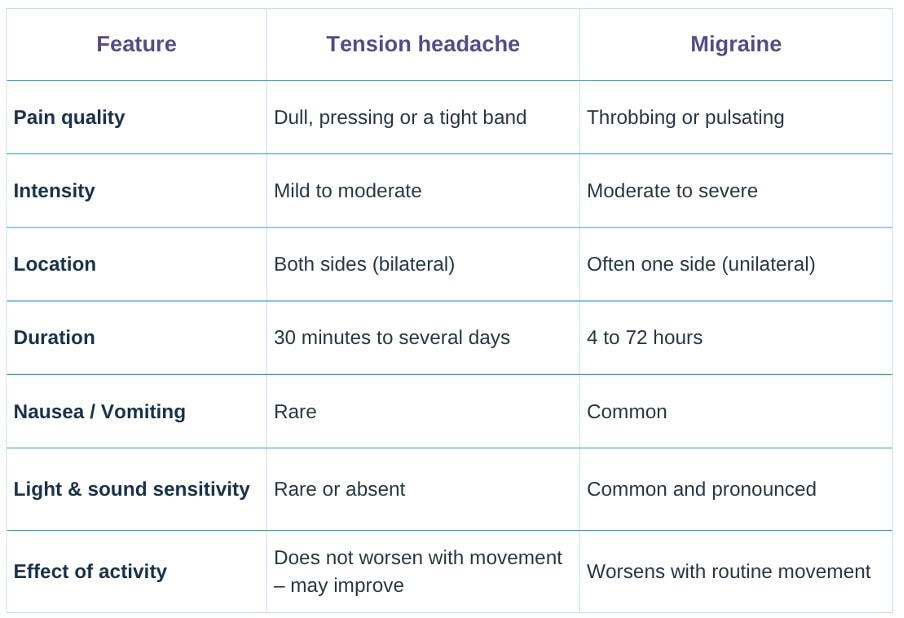
Tension headache or migraine?
Tension headache and migraine are different conditions, although some people experience both. Both are known as primary headache disorders.
Tension headache usually causes a steady ache or feeling of tightness, while migraine often causes moderate to severe throbbing pain. Migraine is also much more likely to cause nausea, vomiting and sensitivity to light and sound, and often makes it difficult to carry on with normal activities.
Tension headache isn’t normally made worse by walking, climbing stairs or other everyday physical activity. Physical activity usually makes migraine symptoms worse. Some people may notice mild sensitivity to light or sound with tension headache, but it’s usually not as bad as it is with migraine. It’s not typical to feel sick with tension headache.