
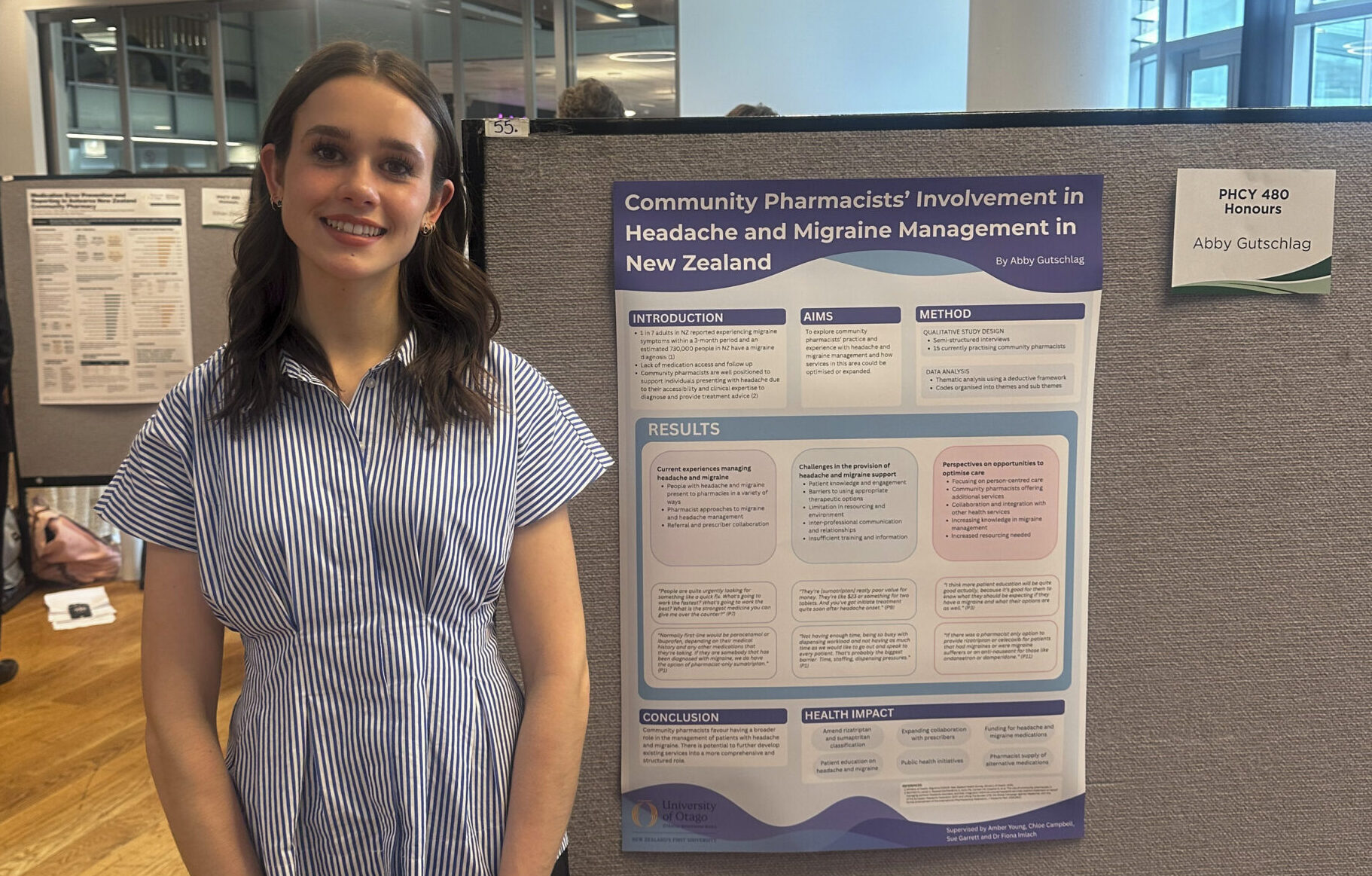
In this guest blog, Abby Gutschlag shares findings from her research into the role of community pharmacists in migraine management in Aotearoa New Zealand. We were honoured to have Abby working on this topic for her Honours research project!
Kia ora! My name is Abby Gutschlag and I’m a fourth-year pharmacy student at the University of Otago, based at the Dunedin campus. I have spent the summer and year in 2026 working with Fiona Imlach, Susan Garrett, Chloe Campbell and Amber Young on a project titled Exploring community pharmacists’ involvement in headache and migraine management in New Zealand.
Our project aimed to explore community pharmacists’ current practices and experiences with headache and migraine management, and how services in this area could be optimised or expanded. This research was prompted by a position statement published in 2025 by the European Headache Federation and Lifting the Burden (the Global Campaign), which advocated for the integration of community pharmacists into structured headache services. The proposed role recognises that pharmacists are accessible healthcare professionals who could provide additional support to people experiencing headache and migraine, particularly those who are able to self-manage their condition.
Our research aimed to understand whether community pharmacists in New Zealand would be willing to take on a broader role in this area and what resources and support would be needed to make this possible.
We interviewed 15 currently practising community pharmacists from around New Zealand to explore their experiences managing headache and migraine in the community, the challenges they face, and the opportunities and requirements to improve care.
Current experiences
People experiencing headache and migraine symptoms present to community pharmacies in a variety of ways. This may be to seek advice about their symptoms, purchase over-the-counter (OTC) medicines, or collect prescriptions for an established diagnosis.
Pharmacists described using a range of approaches to support these patients, including assessing symptoms, recommending and supplying medicines, providing education and discussing lifestyle management. The advice provided often depended on the patient’s symptoms, previous treatment experiences and individual needs. Pharmacists also recognised the importance of identifying when a patient may need further assessment or treatment from another healthcare professional. This included recognising potential red flags, identifying concerns around medication use and referring patients to their GP when appropriate.
These findings suggest that pharmacists are already involved in several aspects of headache and migraine management. However, there is potential to develop these existing practices into a more comprehensive and structured role.
Challenges
Although pharmacists recognised the value of supporting people with headache and migraine, several challenges were identified that can limit the care they are able to provide.
One challenge was limited patient understanding of headache and migraine, including the available treatment options and the role community pharmacists can play in providing support. This can make it difficult for pharmacists to engage patients in discussions about their condition, treatment and self-management.
Pharmacists also identified limitations with the medicines available to them. Restrictions around pharmacist-only supply of sumatriptan, along with the limited availability of suitable OTC treatment options, could make it difficult to provide patients with timely access to appropriate treatment. The cost of some treatment options was another concern, particularly when patients were required to access medicines that were not funded.
Time and workload pressures were also commonly discussed. Community pharmacists have a range of responsibilities, including dispensing, medicine supply and other pharmacy services. With high patient demand and limited staffing, finding the time to provide more comprehensive consultations for people with headache and migraine can be challenging.
Other challenges included insufficient training and resources to support pharmacists in their assessment and management of headache and migraine. Pharmacists also described difficulties communicating with GPs, which could make it harder to share patient information, discuss treatment concerns and coordinate care.
Opportunities and requirements to expand care
Despite these challenges, pharmacists generally supported having a broader role in the management of people with headache and migraine. Participants identified several opportunities to improve the care currently provided within community pharmacies.
One opportunity was increasing patient education and awareness. Pharmacists felt they could provide more personalised advice around headache and migraine symptoms, treatment options and lifestyle management. Improving public awareness of the services available through community pharmacies may also encourage more people to seek support.
Participants also discussed opportunities to expand the treatment options available through community pharmacies. This included reviewing current restrictions around pharmacist-only supply of medicines such as sumatriptan and rizatriptan, as well as considering additional treatment options that could improve access to care.
Improving communication and collaboration between pharmacists and other healthcare professionals was another important consideration. Better communication with GPs and access to shared patient information could support pharmacists in making informed clinical decisions and providing more coordinated care.
However, participants recognised that expanding the pharmacist’s role would require additional support. Further education and training in headache and migraine management was identified as an important requirement, particularly around clinical assessment, treatment options and recognising when referral is needed. This training would need to be practical and accessible, with pharmacists also having sufficient time and resources to put their learning into practice.
Finally, increased staffing and appropriate funding models were identified as important to support the delivery of additional pharmacy services. Without adequate time and financial support, it may be difficult for pharmacies to provide more comprehensive care while continuing to meet their existing responsibilities.
Key takeaways
Overall, the community pharmacists interviewed were in favour of having a broader role in the management of people with headache and migraine. Many of the proposed responsibilities are already being undertaken to some extent, particularly providing advice, supplying medicines and educating patients. However, there is potential to build on these existing services and develop a more structured approach to headache and migraine care within community pharmacy.
Our findings highlight that expanding the pharmacist’s role is not simply about providing additional services. It also requires addressing the barriers that currently limit care, including patient awareness, access to treatment, pharmacist education, time pressures and communication with other healthcare professionals.
Community pharmacists are an accessible part of the primary healthcare system and are well placed to provide support to people experiencing headache and migraine. Better use of this existing healthcare workforce, alongside appropriate training, resources and collaboration, could help improve access to timely and appropriate care for people living with headache and migraine in New Zealand.
It was encouraging to hear that pharmacists recognised the potential to contribute more to headache and migraine management and were interested in how their current role could develop. I hope this research helps contribute to the ongoing discussion around improving headache and migraine care in New Zealand.
Ngā mihi nui to all the pharmacists who took the time to participate in our interviews and share their experiences. I would also like to thank my supervisors, Fiona Imlach, Susan Garrett, Chloe Campbell and Amber Young, for their support and guidance throughout this project.