
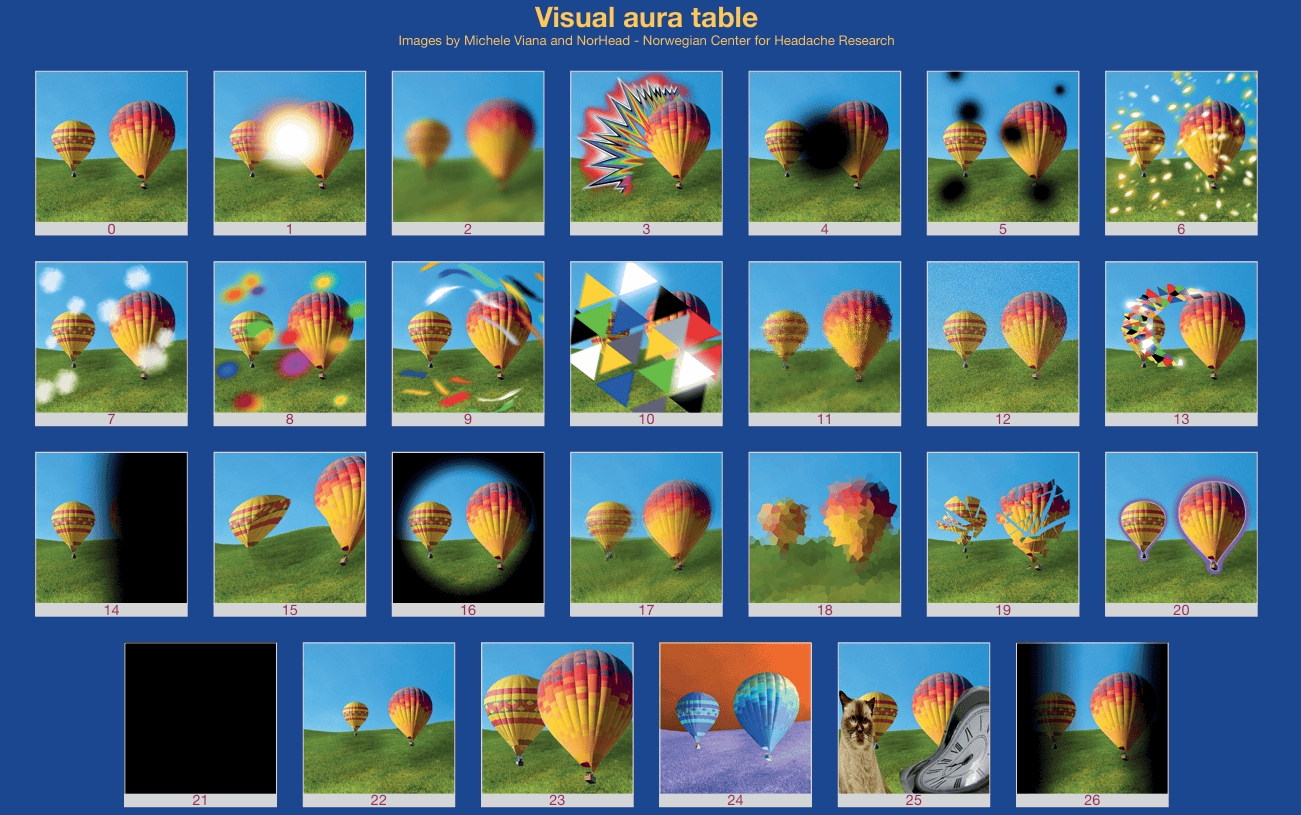
As many as 30% of people with migraine experience ‘aura’, a period of visual or other sensory disturbance occurring before the headache begins. Some people have an aura and never develop the headache – this can be known as a silent migraine, migraine aura without headache or acephalpgic migraine.
Most migraine auras are visual in nature but they vary tremendously across individuals and even from one attack to another. They can also change over time. Some people only occasionally experience an aura with a migraine attack, but other attacks are aura-free. Some people have them more often when they are younger or they come on in older age. Aura is less likely to occur with menstrual migraine.
Migraine aura can be mistaken for a stroke as the symptoms can be identical – loss of vision, changes in sensation on one side of the face, difficulties in speaking. But unlike stroke, migraine aura usually lasts only for 20-60 minutes and resolves completely.
If you’ve ever struggled to describe how a migraine aura affects your vision, there is now a set of standardised pictures that were tested on a large group of patients who had migraine with aura. This is available online from the International Headache Society, with the original images and research published in Cephalalgia.
It shows representations of 26 different types of visual aura. The most common (experienced by 80% or more of the research sample) were:
- Total blindness (picture 21)
- Oscillopsia or movement of stationary objects (picture 17)
- Multiple ‘scotomas’ or holes in the vision (picture 5)
- Micropsia or perceiving objects to be smaller than they actually are (picture 22)
- Fractured objects (picture 19)
- Like looking through heat waves, water or oil (picture 11)
- Zig-zag lines (picture 3)
- Foggy or blurred vision (picture 2)
- Hemianopsia or loss of half of the visual field on the left or right side (picture 14)
- White dots or round forms (picture 7)
- Small bright dots (picture 6)
- ‘Bean-like’ forms (picture 13)
Still quite common (50-79%)
- Prisms/geometric shapes (picture 10)
- Macropsia or perceiving objects to be larger than they actually are (picture 23)
- Mosaic vision (picture 18)
- Tunnel vision (picture 16)
- Single scotoma or hole in the vision (picture 4)
- Deformed images (picture 15)
- Coloured lines (picture 9)
- Corona effect or an extra edge on objects (picture 20)
- Tiny flickering dots (picture 12)
- Bright light (picture 1)
- Altered colours (picture 24)
Coloured dots or round forms were experienced in less than half (picture 8) but very uncommon were complex hallucinations (picture 25) and curtain phenomenon (visual loss from both sides of the visual field, picture 26).
A picture really can paint a multitude of words – use these pictures to show others (family, health professionals, work colleagues) what your migraine aura can look like.
Thanks to Dr Michele Viana and colleagues for sharing these images and allowing free circulation.