
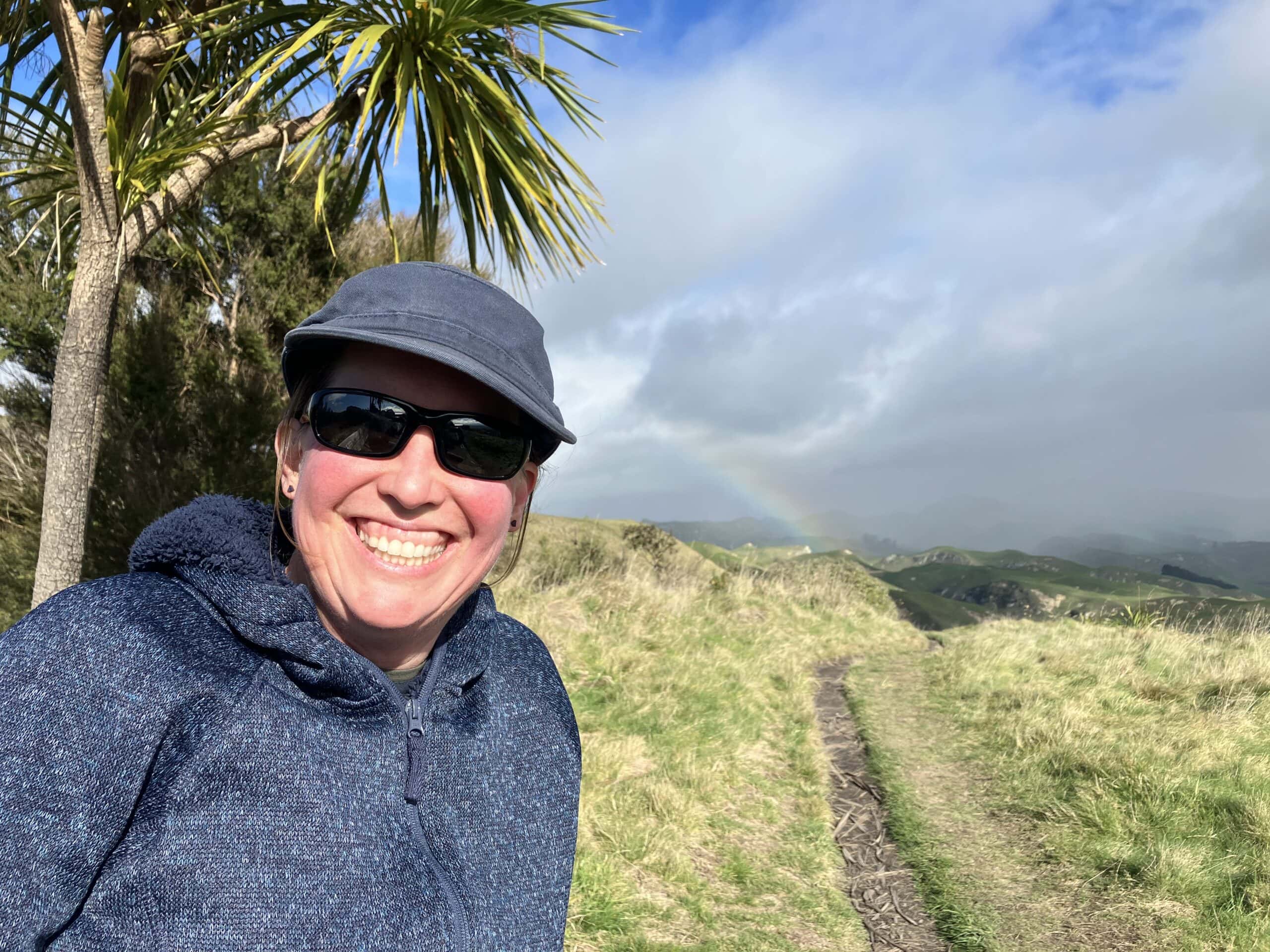
Monique (pictured above) has been living with chronic migraine for over 20 years. In this guest blog she shares her transformative experience of working with a pain recovery coach.
Over the 20+ years that I’ve had chronic migraine, I tried everything I thought might help. Dietary changes? Check. Over 10 preventative medications? Check. Meditation? Check. Bee venom therapy? Check. Bite guard? Check. The list is too long and costly to comprehensively tally. My life became very small. I cut out all known migraine trigger foods, I avoided loud and bright places, and I kept a strict sleep schedule. I lived in fear since almost anything could tip my sensitive system into a migraine.
In early 2025, my neurologist in New Zealand suggested Aquipta. Miraculously, it cut my migraine days in half almost immediately. I relished the fact that I now had only 10-11 migraine days a month. Relief is relative to your lived experience! Then a friend of a friend recommended that I meet with a pain recovery coach.
I was not immediately sold on the idea. As a type A, highly-motivated person, I’d already listened to podcasts and read a variety of books about the science of pain. I had learned that neuroplastic pain, also known as TMS (Tension Myositis Syndrome) and MBS (Mind-Body Syndrome), is a type of chronic pain that is caused by misfiring in the brain instead of tissue damage in the affected part of the body. It can show up as migraine, knee pain, dizziness, back pain, repetitive strain injury, dry eyes, irritable bowel syndrome (IBS) and many other seemingly mysterious and frustrating symptoms. The idea that my body was stuck in fight-or-flight really resonated with me, but implementing the popular strategies – journaling, somatic tracking (noticing sensations without judgement), renaming symptoms as “sensations” and pain as “discomfort”, etc.—didn’t ease my migraine attacks at all.
Nevertheless, I skeptically booked a consultation with the pain recovery coach in October of 2025. I was immediately hooked! It quickly became very clear that WHAT I had been doing to address my pain wasn’t nearly as important as HOW I was doing those things. As a perfectionist, when I tried to do all of the strategies perfectly, I was only sending danger signals to my brain. I needed to send messages of safety instead. This approach to pain is simple but not necessarily easy. The neurological pathways in my brain have been wired for danger for years, so it takes a great deal of persistence and self-compassion to redo that wiring.
Your pain is real and intense. However, relief may not be found where you’re looking. You don’t necessarily have to change your life to feel better. It could be about changing how your nervous system responds to your life. Folks with chronic pain, including migraine, often have a sensitive nervous system. Instead of focusing on the smoke alarm (e.g. migraine symptoms), we need to bring more awareness to what’s starting the fire—is it a past history of trauma? Is it a personality trait like perfectionism? Is it catastrophizing when symptoms creep up (like that negative voice in my head)?
Here are a few of my favourite takeaways from pain recovery coaching:
- I’ve learned that my job isn’t to make the symptoms disappear. Instead, my only task is to see if I can nudge myself towards neurological safety, even just a little bit.
- 10-15%: Doing anything to perfection, whether it’s meditation or exercise or something else, is stressful. When I feel symptoms creep up, I’ve shifted my goal from “I’ll meditate to make this migraine attack go away” to “I’ll meditate to see if I can calm my nervous system by just 10-15%.”
- Shifting from judgement to self-compassion: Instead of berating myself for not adequately taking care of myself or overreacting to life’s inevitable stresses, I started asking myself “Why does this flare-up make sense?”
- Noticing the voice in my head: When I feel symptoms creeping up, the voice in my head insists that a migraine is inevitable, probably the result of not taking care of myself well enough, and that there’s nothing I can do. It turns out that voice is always catastrophizing! I can’t stop that internal voice from giving its opinion, but I can notice its presence and its negativity bias, and introduce a different idea. My pain recovery coach and I settled on “maybe not!” Now when the voice in my head insists that a migraine is inevitable, I counteract with “maybe not!”
- Creating an evidence list: Our brains love patterns but, unfortunately, it has a negativity bias. It’s easy to correlate triggers and experiences with migraine attacks. We have to actively notice the reverse–when a migraine does not follow a suspected trigger, when a migraine does not materialise even when we’re convinced it’s inevitable. This evidence list builds confidence, which increases a sense of safety when sensations appear.
As I implemented these strategies, my migraine symptoms were magically disappearing. After a very long travel day, I felt my familiar pre-migraine symptoms. I reassured myself that I’d take medicine after I took a warm shower. While in the shower, I listened to the voice in my head telling me that not only was a migraine inevitable given my travel day, but that I would likely experience medication over-use symptoms since I’d probably need to take a lot of medication during my trip. I literally giggled in the shower when I noticed my brain’s deeply negative bias. No migraine. More often than not, this type of subtle shift in my mental patterns now results in my pre-migraine symptoms dissipating rather than intensifying.
I had always assumed that my pain was different. That I was different. Approaches that helped other people could never help me. Do you also have those thoughts? I urge you to suspend your skepticism. A skilled pain recovery coach can identify sticky areas on your path to safety, and mine taught me so much. I initially met with my coach weekly, but frequency and total sessions can be easily adapted to the individual. The frequency of my migraine attacks dropped in half within my first few sessions, and I’m still making progress! I am much kinder to myself. I feel empowered when I notice the usual “sensations” creeping up, instead of frozen in fear. I know I can handle what comes next.
As I type this post, I’m eighteen days out from my last migraine attack. Those eighteen days included my menstrual period, two eye exams including eye dilation and very bright lights, and several servings of my mum’s delicious spaghetti. Her sauce is all the more delicious from the sausage, red wine and aged cheese sprinkled on top—all traditional migraine triggers for me. The old me can hardly believe my big, vibrant life now! Old habits die hard though. The negative voice in my head is still there, telling me that I’m “overdue” for a migraine. My response? Maybe not!
My recommended resources
Directories of pain recovery coaches*
- Freedom From Chronic Pain
- Association for the Treatment of Neuroplastic Symptoms
*Since many of these coaches work virtually, geographic location isn’t a barrier to finding the right support.
Books
- The Way Out: A Revolutionary, Scientifically Proven Approach to Healing Chronic Pain, Alan Gordon and Alon Ziv
- They Can’t Find Anything Wrong!, David Clarke MD
- When the Body Says No, Gabor Maté MD
- Unlearn Your Pain: The Science of Recovering from Chronic Pain, Fatigue, Anxiety, and Depression, Howard Schubiner MD
- Tell Me Where It Hurts: The New Science of Pain and How to Heal, Dr. Rachel Zoffness
- The Pain Management Workbook: Powerful CBT and Mindfulness Skills to Take Control of Pain and Reclaim Your Life, Dr. Rachel Zoffness
Podcasts
- Like Mind, Like Body
App
- Curable (immediate, practical exercises)
Recipe for Sandra’s Spaghetti Sauce
2 Tbsp. olive oil
2 onions, diced
4 cloves of garlic, diced
1.5 kg of sausage, removed from casings and crumbled into small pieces
2 Tbsp. Italian seasoning
150g tomato paste
2 kg canned whole, peeled tomatoes
1 bottle of red wine
pinch of brown sugar
Salt and pepper to taste
Heat olive oil in a large pot over medium heat. Add diced onions, and cook for about ten minutes.
Add diced garlic and crumbled sausage. Cook until the sausage is no longer pink.
Drain off excess fat.
Add canned tomatoes (with juice), tomato paste, red wine, brown sugar, salt and pepper.
Cover pot and cook on low heat for approximately four hours.